Tuesday, 15 September 2015

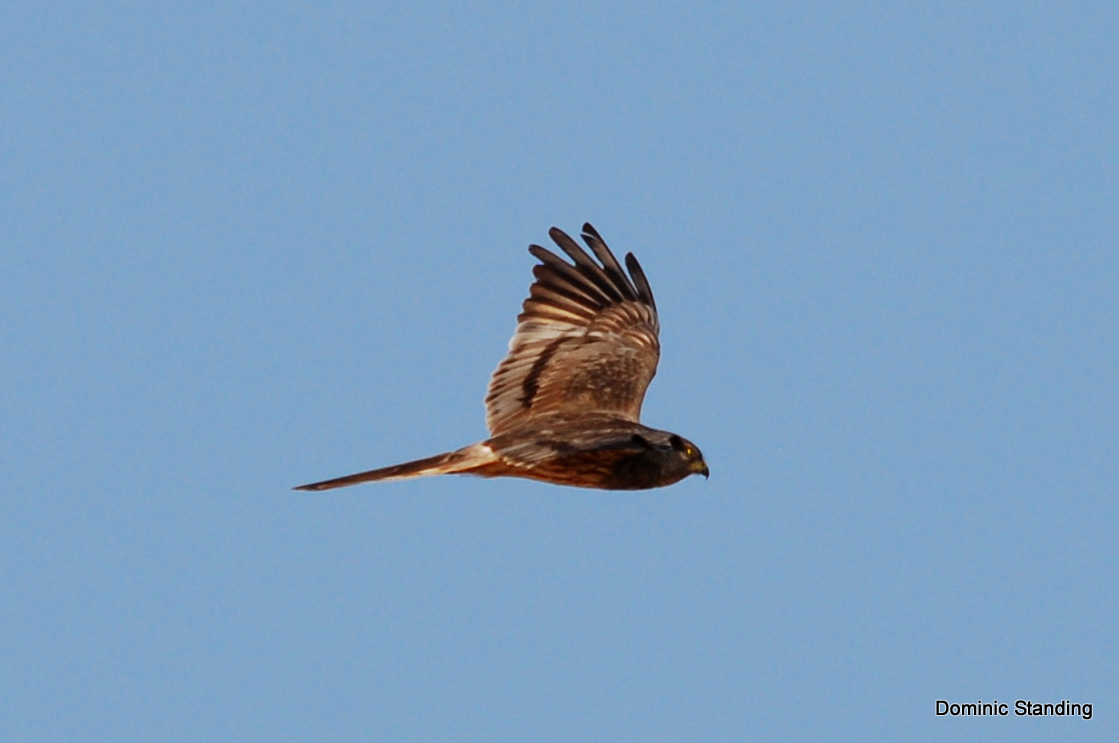
Montagu's Harrier (but better views)

Now this is a Montagu's Harrier! So much better views than the one last week in the dust cloud. This adult male was above the road back from Besor Reservoir this morning. What a beauty!


The water level in the reservoir is now so low that there are large areas of mud. Great for Temminck's Stint (patch tick),

Marsh Sandpiper, Ringed Plover etc but a lot of the herons and egrets have gone. Yesterday I saw two Spotted Crakes and a Water Rail but didn't manage any photos worth the name. This morning was crakeless but there are now two Water Rails.

The Purple Swamphens are out in force - this is one of three around this small patch of water.


Can't really see the obvious green on the back that our local subspecies has. Trick of the light or the European nominate? 


Snipe have always intrigued me and this one is no exception. Looks like it has Great Snipe type spotting on the covert tips, forming bars.

Nice Wryneck by the car park on the way out.


Friday, 11 September 2015

Ortolan buntings, Rollers etc

Saw a couple of Levant Sparrowhawks yesterday evening so got up early to see if any more were around. No luck but a young Golden Oriole gave good views and I found a small flock of five Ortolan Buntings. Amazingly, this is a Nir Oz patch tick (154, same as for Besor Reservoir). For some reason this common migrant doesn't move through this area, not in large numbers anyway.


The photos above were with the Nikon plus Sigma 150-500. The ones below were with the Canon SX50. This time I prefer the Nikon pictures. However, I noticed that the Nikon disturbs birds (bigger 'eye', noisier) and carrying it around is, quite frankly, a pain, but often the image quality is better and it is so nice to use a proper viewfinder, not an EVF. The ease of use, quietness, reach and portability means that the Canon is my every day camera. Each camera has its strengths and I'd be loathe to have to choose between them.


Northern Wheater - one of a large number on the fields now. This bird was disturbed by me taking photos with the Nikon - it was unperturbed until I took this photo but flew off before I could get another shot. I suspect the whirr of image stabilisation motors and shutter clunk did the trick.

This evening produced three Golden Orioles, one Red-backed Shrike and one Wryneck in the trees around my house - quality birds!


Nice couple of Roller yesterday, on my way to work. The local ones left weeks ago so these must be northern birds moving through. This is a young bird - very much duller than an adult.


Wednesday, 9 September 2015

Montagu's Harrier

Appalling weather at the moment - very hot, humid, and very dusty. Visibility is down to 800m at times and I've more or less resigned myself to a dull and bird free few days until the dust cloud passes.

However, on the way back home through the kibbutz fields this afternoon a cracking female Montagu's Harrier was hunting. Monty's is the least common harrier here - very pleased with this sighting. No apologies for the photos - the conditions were, as mentioned, appalling.


 The local fields . . . .

Friday, 4 September 2015

Black-winged Kites - both vociferus and caeruleus together?

UPDATE: Long story short: no, it looks like these are two vociferus birds. The hugely experienced Barak Granit pointed out that the 'odd' bird had shading on the secondaries and this is similar to many of the vociferus birds he's seen here. Ok, we live and learn - that's the fun of it!

(with thanks to all those who offered advice)


Went out again this afternoon to 'do more research'. Found both birds several km away near Ein Hashlosha.

So, two birds, one obviously vociferus with the black trailing edge to secondaries,

but the second bird . . .


. . . clearly does NOT have a black trailing edge to the secondaries - E. c. ceruleus? I'm inclined to think so but I'm open to discussion.

Hooded Crow being tough but the kite saw it off.

Eventually, mutual respect.

Black-winged Kite

I suspected that the Black-winged Kites that I saw up until the beginning of July had not flown off and I've been checking likely looking areas but with no luck. Until today! This bird was in a roadside tree between Nir Oz and Nirim.


But wait! The underwing doesn't appear to have a continual dark trailing edge as in the birds seen earlier this year. This looks like the African subspecies (Elanus caeruleus caeruleus). This is a mystery that needs resolving. . . . more research is needed.

Loads of Kingfishers around Besor Reservoir this morning. The water level is rapidly dropping and I really hope that rains come early this year otherwise the reservoir will become a dust bowl.

The Purple Swamphens were out in force - seven in total, all giving reasonable views as they skulked by the reed bed edges.


Looks like the BCBs have finally gone south.

Tuesday, 1 September 2015

Golden Orioles, even more BCBs, wagtails, shrikes etc

Great to see Golden Orioles are back. I see them every Spring and Autumn as fleeting shadows flying out the back of tree canopies but hardly ever get a chance to see them properly. Such shy and elusive birds. This female was in the trees on the south side of the kibbutz. Elusive but I finally managed a half-decent view.


Bit odd to see a Northern Wheatear in a tree.

And back to Besor . . . Yellow Wagtail season is upon us once again and once again I'm caught out by young ssp beema. At first glance they can look confusingly similar to Citrine but a second glance shows head pattern, bill and wing bars are all wrong for Citrine (bill not pure black but with pale base to under mandible, wing bars not strong enough, yellow tinge on primaries, dark lores, no pale around the ear coverts).


 This flavissima is a bit easier though.

Nice Isabelline Wheatear, standing to attention as they so like to do.

Yesterday BCB numbers rose to a staggering 130! 59 at Besor Reservoir with the remainder at the dried up reservoir a couple of km to the NW. Once again the electricity wires were dripping with them. These numbers rival those at the Beit Shean valley.


And finally a flight shot!

Decided that I really need to use the DSLR a bit more - the SX50 is really not very good for flight shots. But the Nikon is much better . . . . Whiskered Tern over the water

Shrikes still in abundance, Red-backed with a meal


 juvenile Red-backed,

Lesser Grey with a meal.


Lots of other migrants coming through now - Lesser Whitethroats, Whitethroats etc.

NW India - 9th to 22nd February 2020 (Kosi River, Corbett NP, Haripur Dam, Pangot, Sattal, Chopta, Walterre)

If you look through the Birds of the Indian Subcontinent (Grimmett, Inskipp and Inskipp, 2011) you cannot help noticing the huge range of s...