If you look through the Birds of the Indian Subcontinent (Grimmett, Inskipp and Inskipp, 2011) you cannot help noticing the huge range of species whose common distribution falls in an enticing curve along the Himalayas. A small part of the westerly portion was the destination for my brother's and my annual birding holiday together. To try and minimise travel we decided to follow the well worn route of Kosi River/Corbett NP-Pangot-Sattal. However, both of us were enticed by the Himalayan Monal - a bird of mythical plumage - and to reach the mountain slopes that Monal like meant an additional day's trip in each direction. Potentially, this was two days lost to more productive birding elsewhere but we were happy with the compromise. We weren't neccessarily chasing quantity and our major target species were Ibisbill and Himalayan Monal, although we had a long subsidiary target
list. We settled on our itinerary with Asian Adventures. This is an excellent company to work with and they booked our accommodation, guide and driver, all at very reasonable cost. Mahesh Rajpoot, our guide, was extraordinarily sharp eyed and eared and very little escaped him. Pawan Kumar, our driver, was no slouch as a birder either. Pawan was an excellent driver who negotiated the Delhi/urban chaos and hair-raising Himalayan roads with confidence.
09.02.2020 - Delhi to Tiger Camp
Rod, Pawan, a representative for Asian Adventures and I met at IGI Airport, Delhi. After sorting out the finances with the rep we set off for Corbett NP and the Kosi River. Pawan stopped on a bridge over the Ramnagar River and we notched up our first 30 species (River Lapwing, Citrine, White and White-browed Wagtails, waders etc) as the bridge oscillated alarmingly with each passing truck. We reached Tiger Camp, Corbett NP in the evening. Mahesh was waiting to greet us and we arranged to meet early the next morning to start birding proper.
10.02.2020 - Tiger Camp (Kosi River)
The profusion of birds was dizzying - Blue Whistling Thrush, Indian Grey Hornbill, Rufous Treepie were seen before we left the hotel while Grey-capped Pygmy Woodpecker, Grey-headed Canary Flycatcher, Yellow-bellied and White-throated Fantails and a flock of gloriously red-and-black (male) and yellow-and-black (female) Long-tailed Minivets were found on the road to Girija Diva Temple on the Kosi River where we were to start our search for Ibisbill. Mahesh was keen to get an early start on this bird as there was only one individual this year and it was a target species for every group of birders. Despite Mahesh's gentle exhortations to hurry up Rod and I found it impossible to ignore the riverside birds - the first of many White-capped and Plumbeous Redstarts were seen perching on the smooth river rocks, Black-throated Thrush, Tickell's Blue and Taiga Flycatchers,


Long-tailed Shrike,

Booted Warbler and a handful of Rosy and Paddyfield Pipits were all seen in the first 200 m of our walk. Rosy Pipit - the rose coloured throat and breast patch stood out in certain lights but wasn't always obvious.

 We weren't the only birders there and Mahesh was in contact with other guides/groups regarding sightings of the Ibisbill. No one had seen the bird yet despite the coverage so it was a huge relief when Pawan located it feeding amongst rocks along one of the river streams. Superb views of Ibisbill in the morning light!


 On the way back to the car we caught sight of an odd looking wheatear. This was a surprise as we weren't expecting to see any wheatears on this trip, least of all a (female) Variable Wheatear.
 We cut through the village picking up a flock of Black-chinned Babblers, Himalayan Bulbul, Bar-tailed Flycatcher Shrike, Grey-hooded Warbler, our only Brahminy Starling of the trip, Indian and Oriental Magpie Robins. Downstream of the temple we found Crested Kingfisher,

a small group of White-capped Buntings,
 Rock Buntings, Crested Serpent Eagle and a single Besra hunting along the ridge.
After lunch we headed for Kumeria picking up Chestnut-bellied

 and Velvet Nuthatches, a distant flock of Crested Treeswifts hawking for insects and a very approachable Crested Serpent Eagle sitting in a tree by the road, utterly ignoring the steady passage of trucks, cars and motorbikes passing below.


Bay-backed Shrike, Green-tailed Sunbird, Bronzed Drongo, Oriental White-eye,

 Jungle Babbler were seen, along with superb views of Brown Fish Owl

 followed a few metres further on by Tawny Fish Owl!
 While we were scoping the owl a male Green-tailed Sunbird flitted past my shoulder and sat, perfectly posed for a single glorious second in a bush within hand's reach. The usual restarts hopped amongst the river rocks together with a Brown Dipper. As the light faded we headed back to the hotel, stopping at a vantage point high above the river valley to watch a distant Pallas's Fish Eagle. Not so distant was a very noisy and brilliantly coloured Himalayan Goldenback checking out nesting sites in the upslope trees. Gloaming birds of the day were an Asian Barred Owlet and, while we were on the roadside verge watching it, an overflying Large-tailed Nightjar.
11.02.2020 - Tiger Camp (Kosi River and Corbett NP)
Great views of Red-whiskered Bulbul from our room balcony.

We got into the car for the short drive to Mohaan but stopped a few hundred meters from the hotel for Lineated Barbet, Little Pied and Slaty-blue Flycatchers. A little further on we piled out of the car again to watch Greater Goldenback
 and Himalayan Goldenback.

Pawan dropped us along the Mohaan road, thick woods on either side, to look for the elusive Nepal Cupwing. While we were slowly birding down the road we heard the deep honking call of a Great Hornbill and I was lucky enough to see a brief glimpse of it as it flew off through the trees. We located the Nepal Cupwing by call but, apart from a few micro-second views it remained deep in the vegetation. Giving far better views was a very pretty Whistler's Warbler. We gave up on getting better views of the cupwing and were walking back to the car when Mahesh spotted a pair of Collared Falconet! This was a bird I have long wanted to see and a key target for the trip.


 While we were watching these two little beauties Mahesh called our attention to a Red-billed Blue Magpie. What an amazing morning! Our lunch break was pretty spectacular too - Rod and I had a half hour to spare so we checked out the scrub near the river. Fantastic views of Black-throated Thrushes on a lawn,


 The next two lunchtime birds were also really special: a Verditer Flycatcher that showed beautifully but always in the wrong light for photographs....


 as well as a few Black Bulbuls


as well Short-eard Owl, Marsh Harrier, Greater Coucal, Common Snipe, Great White Egret, Purple Heron, Grey Francolin, Citrine wagtail, Red-naped Ibis and Zitting Cisticola.








It wasn't long before a pair of Slaty-backed Forktails made their appearance. Fabulous birds!

 Along the waterway we found a Spotted Forktail, Whistler's Warbler, Mountain Bulbul, Whiskered Yuhina, Lemon-rumped Warbler and an absolute gem of a Small Niltava with electric blue forehead and shoulder patches. Unfortunately it stayed in the dark of the opposite bank and once again I'm left with an over post-processed record shot.


Stripe-throated Yuhina,


list. We settled on our itinerary with Asian Adventures. This is an excellent company to work with and they booked our accommodation, guide and driver, all at very reasonable cost. Mahesh Rajpoot, our guide, was extraordinarily sharp eyed and eared and very little escaped him. Pawan Kumar, our driver, was no slouch as a birder either. Pawan was an excellent driver who negotiated the Delhi/urban chaos and hair-raising Himalayan roads with confidence.
09.02.2020 - Delhi to Tiger Camp
Rod, Pawan, a representative for Asian Adventures and I met at IGI Airport, Delhi. After sorting out the finances with the rep we set off for Corbett NP and the Kosi River. Pawan stopped on a bridge over the Ramnagar River and we notched up our first 30 species (River Lapwing, Citrine, White and White-browed Wagtails, waders etc) as the bridge oscillated alarmingly with each passing truck. We reached Tiger Camp, Corbett NP in the evening. Mahesh was waiting to greet us and we arranged to meet early the next morning to start birding proper.
10.02.2020 - Tiger Camp (Kosi River)
The profusion of birds was dizzying - Blue Whistling Thrush, Indian Grey Hornbill, Rufous Treepie were seen before we left the hotel while Grey-capped Pygmy Woodpecker, Grey-headed Canary Flycatcher, Yellow-bellied and White-throated Fantails and a flock of gloriously red-and-black (male) and yellow-and-black (female) Long-tailed Minivets were found on the road to Girija Diva Temple on the Kosi River where we were to start our search for Ibisbill. Mahesh was keen to get an early start on this bird as there was only one individual this year and it was a target species for every group of birders. Despite Mahesh's gentle exhortations to hurry up Rod and I found it impossible to ignore the riverside birds - the first of many White-capped and Plumbeous Redstarts were seen perching on the smooth river rocks, Black-throated Thrush, Tickell's Blue and Taiga Flycatchers,


Long-tailed Shrike,

Booted Warbler and a handful of Rosy and Paddyfield Pipits were all seen in the first 200 m of our walk. Rosy Pipit - the rose coloured throat and breast patch stood out in certain lights but wasn't always obvious.


a small group of White-capped Buntings,

After lunch we headed for Kumeria picking up Chestnut-bellied


Bay-backed Shrike, Green-tailed Sunbird, Bronzed Drongo, Oriental White-eye,


11.02.2020 - Tiger Camp (Kosi River and Corbett NP)
Great views of Red-whiskered Bulbul from our room balcony.

We got into the car for the short drive to Mohaan but stopped a few hundred meters from the hotel for Lineated Barbet, Little Pied and Slaty-blue Flycatchers. A little further on we piled out of the car again to watch Greater Goldenback


Pawan dropped us along the Mohaan road, thick woods on either side, to look for the elusive Nepal Cupwing. While we were slowly birding down the road we heard the deep honking call of a Great Hornbill and I was lucky enough to see a brief glimpse of it as it flew off through the trees. We located the Nepal Cupwing by call but, apart from a few micro-second views it remained deep in the vegetation. Giving far better views was a very pretty Whistler's Warbler. We gave up on getting better views of the cupwing and were walking back to the car when Mahesh spotted a pair of Collared Falconet! This was a bird I have long wanted to see and a key target for the trip.


and then, near a small shack, three pipits flew up into a tree. After a bit of slow and careful stalking I had some partial but great views of Olive-backed Pipit. OBP is supposed to be a very fair bet here but these were the only ones we saw. Another longed-for lifer.


and a very nice Hume's Warbler.

That was an amazing lunch-break.
The afternoon was taken up with a tiger safari in Corbett NP proper. Given the emphasis on tiger safaris in this area and their mass tourism appeal I was a bit suspicious of this part of the trip. I assumed that the emphasis would be on showing tourists large mammals at the expense of avaian species. I was competely wrong and it turned out to be an absolutely thrilling highlight of the trip. At the encampment bordering the inner NP we found a Ficus tree packed with Lineated and Coppersmith Barbets


feasting on the fruit. Entering the reserve proper we saw our first Common Iora, Velvet-fronted Nuthatch


and Lesser Yellownape. We drove slowly along the track but were held up by a stopped jeep. After some driver-driver communication we pulled up next to it and were told that a tiger was nearby. A Sambar deer barked an alarm call - it sounded so loud, as though it was just next to us but we saw nothing in the surrounding forest: silence: then a sudden crashing through undergrowth, once again unseen but just next to us: more silence. The tension was incredible. It broke when the guide hissed 'Tiger!' and we saw it about 30 m away. A huge Tiger calmly crossing the track and disappearing into the undergrowth. Mesmerising.

Eventually we refocussed on the birds on carried on, picking up much better views of Crested Tree-swift, Common Iora and a few White-rumped Spinetails. We were starting to run late and the driver was anxious to leave the park but on the way out we saw Changeable Hawk-Eagle


and Streak-throated Woodpecker.

An amazing day and the finish of the Corbett NP lowlands.
12.02.2020 Kosi Barrage, Haripur Dam (Baur Reservoir), Pangot
We left Tiger Camp early, passing a vast flock of Ruddy Shelduck on Kosi Barrage. On the way (Red Junlgefowl by the road) to Pangot we stopped off at Haripur Dam, a huge reservoir also known as Baur Reservoir. The waterfowl was limited in terms of species but the banks and surrounding areas were packed with birds. Yellow-fronted Greenfinch, Pied Bushchat (female and male),


Plain Prinia, Black-throated Weaver, the exceptonally cute Yellow-eyed Babbler,


Ashy Prinia,


and a stunning but too fast to photograph Yellow-bellied Prinia. As we birded slowly along the top bank of the resrvoir we saw the remarkably Siberian Stonechat looking White-tailed Stonechat,


On the water were a couple of Bronze-winged Jacana, Brown-headed Gull, duck (Shoveller, Pochard) and Great Crested Grebes. On the bund track itself a flock of Yellow Wagtails and a couple of Bengal Bushlark kept us company - a beautiful mirafra lark.


Lunch was a disappointing cheese sandwich but an excellent selection of birds were seen - Brown-headed Barbet, Black-throated Thrush and a couple of Spangled Drongo with those incredible tail feathers.

Returning to the main road along the bund we saw a Black-winged Cuckoo-shrike getting mobbed until it flew to refuge in a nearby palm tree. We left the plains and headed up the winding Route 41 towards Pangot. A stop for tea provided superb landscape views as well as our first Black-lored Tit, Great Barbet, Striated Prinia, Himalayan Vulture and a distant view of our only Blue-bearded Bee-eater of the trip. Further on and much higher up we stopped at a piece of waste-ground surrounded by low shrubs. Here, we saw Blue-capped Redstart, Streaked Laughingthrush, Russet Sparrow and both Pink-browed and Common Rosefinches. We arrived at Jungle Lore Lodge to a warm welcome, lunch and more excellent birds: Grey-winged Blackbird,

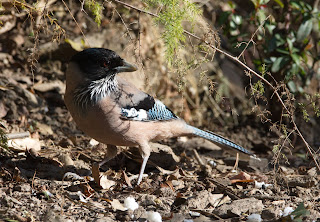
Black-headed Jay,


Blue-fronted Redstart,


Grey-backed Shrike,


Rusty-cheeked Scimitar Babbler,


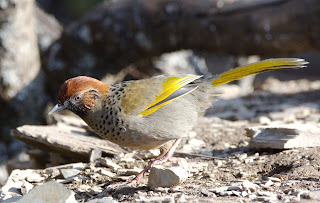
Chestnut-crowned Laughingthrush


Green-backed Tit

and a skulking female Golden Bush Robin.

Rod was feeling pretty exhausted after the long drive so declined an evening jaunt to look for owls. I joined Mahesh and Pawan and we found a pair of Brown Wood Owl as well as hearing a distant Mountain Scops Owl. A short walk up a mountain stream produced two Spotted Forktails.
13.02.2020 Pangot (Cheer Point, Bagar)
Up early to drive to Cheer Point to look for Cheer Pheasants. On the way a party of six Khalij Pheasants crossed the road in front of us. Leaving the forest we saw our first Lammergeier and more Himalayan Vultures circling over the valley. A feeding party of Altai Accentors dropped down the grassy slopes above us but we were unlucky with Cheer Pheasant. We did see Upland Pipit. Walking up the track we re-entered the woods finding a host of woodpeckers: Rufous-bellied, Himalayan, and Brown-fronted. The conditions under the canopy were too challenging for my photographic skills and this is the 'best' shot (record shot, post-processed to within an inch of its life) of the really gorgeous Rufous-bellied Woodpecker I got. I'm adding it purely to give an impression of the beauty of this bird.

The woods also contained calling but always elusive Black-faced Warbler, Black-throated Tit and White-tailed Nuthatch.

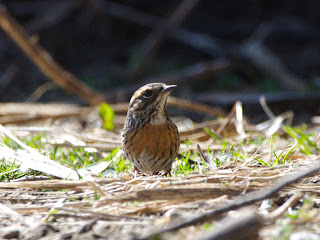
We continued along the track eventually ending at a small village where we saw another Pink-browed Rosefinch, Himalyan Bluetail, Black Francolin and Rufous-breasted Accentor.


Lunch back at Jungle Lore was interrupted by a party of White-throated laughingthrushes and a stunning Spot-winged Grosbeak sitting in a wild cherry tree, calmly demolishing the fruit.


We spent the afternoon at lower altitude, around the village of Bagar. This was an extraordinary place to bird that produced the bird that has been at the top of my most-wanted list for decades - Siberian Rubythroat. The village itself looked likely to be birdy - rank vegetation, fast flowing stream, many cows and piles of manure. Mahesh quickly found one of our target species - Himalayan Rubythroat,


and a skulking but eventually visible Brown-flanked Bushwarbler. The real cherry on the icing for me was when Pawan spotted a Siberian Rubythroat! After several nerve-wracking minutes of seeing leaves twitch and quiver as it moved through the bottom of the vegetation I finally caught a brief but definitive profile view. Wow! Siberian Rubythroat finally seen! The way back also proved productive with a Collared Owlet perched on a tree branch by the side of the road. Excellent views of this tiny owlet including the false 'eyes' on the back of its head.


14.02.2020 Cheer Point (Pangot)
We tried again for Cheer Pheasant in the morning and were again unsuccessful. However, Alpine Thrush, Chestnut Thrush (another photo from the dark shade of the understorey, post-processed to the max),

Altai Accentor, three Kocklass Pheasant, Rufous Sibia, Hill Partridge, Himalayan Bluetail and Black Eagle more than compensated for this one dip.
14.02.2020 Sattal area (Chaffi, Bhimtal, Sattal Road)
After lunch at Jungle Lore we set off for the Sattal part of the trip picking up Great Cormorant and Black-eared Kite on the way. We stopped at Chaffi stream and joined other birders searching for fortktails. A pair of Striated Laughingthrush greeted us as we made our way along a path to the stream.


It wasn't long before a pair of Slaty-backed Forktails made their appearance. Fabulous birds!


A Rufous-gorgeted Flycatcher perched on a rock about 80 m away giving good views for the distance but closer approach was not possible. The final bird of the day was a wonderful surprise. Wren-babblers or Cupwings are tiny, tailless birds with loud calls and are fiendishly difficult to see. We'd heard Nepal Cupwing and we'd heard Scaly-breasted Cupwing. We'd also had fleeting glimpses of both as they flitted from cover to cover. Light was fading fast and we were calling it a day when Pawan pointed excitedly to a fallen branch on the stream side. There, in a blur of fizzing wings and angry chattering was a Scaly-breasted Cupwing! It paused for enough time for us to grab a record shot or two. This was definitely one of the most satisfying sightings of the trip.


15.02.2020 Sattal and environs
We started at the famed bird hide on Sattal Road but with 17 people already packed in we decided to walk down the road instead. Most of the birds were on the downhill side against the morning sun which made photography a bit of a challenge for me. White-crested Laughingthrush, Khalij Pheasant, Red Junglefowl, Grey Treepie, Oriental Turtle Dove,


an impressive pair of White-browed Scimitar Babblers,


a party of fast-moving Red-billed Leiothrix and a Black-throated Sunbird kept us busy. In the canopy a Blue-throated Barbet completed the barbet list. Mahesh heard the call of Orange-bellied Leafbird and we eventually located both male and female. Stunning birds!


Greater Yellownape was seen, bringing our list of woodpeckers to eight.


And then Mahesh heard another of our target birds calling from a shrub nearby - the diminutive Speckled Piculet!

We finished off the morning session with Brown Fish Owl, Himalayan Bluetail,

Bar-tailed Treecreeper, Blue-winged Sivas

and a Grey-sided Bush Warbler.
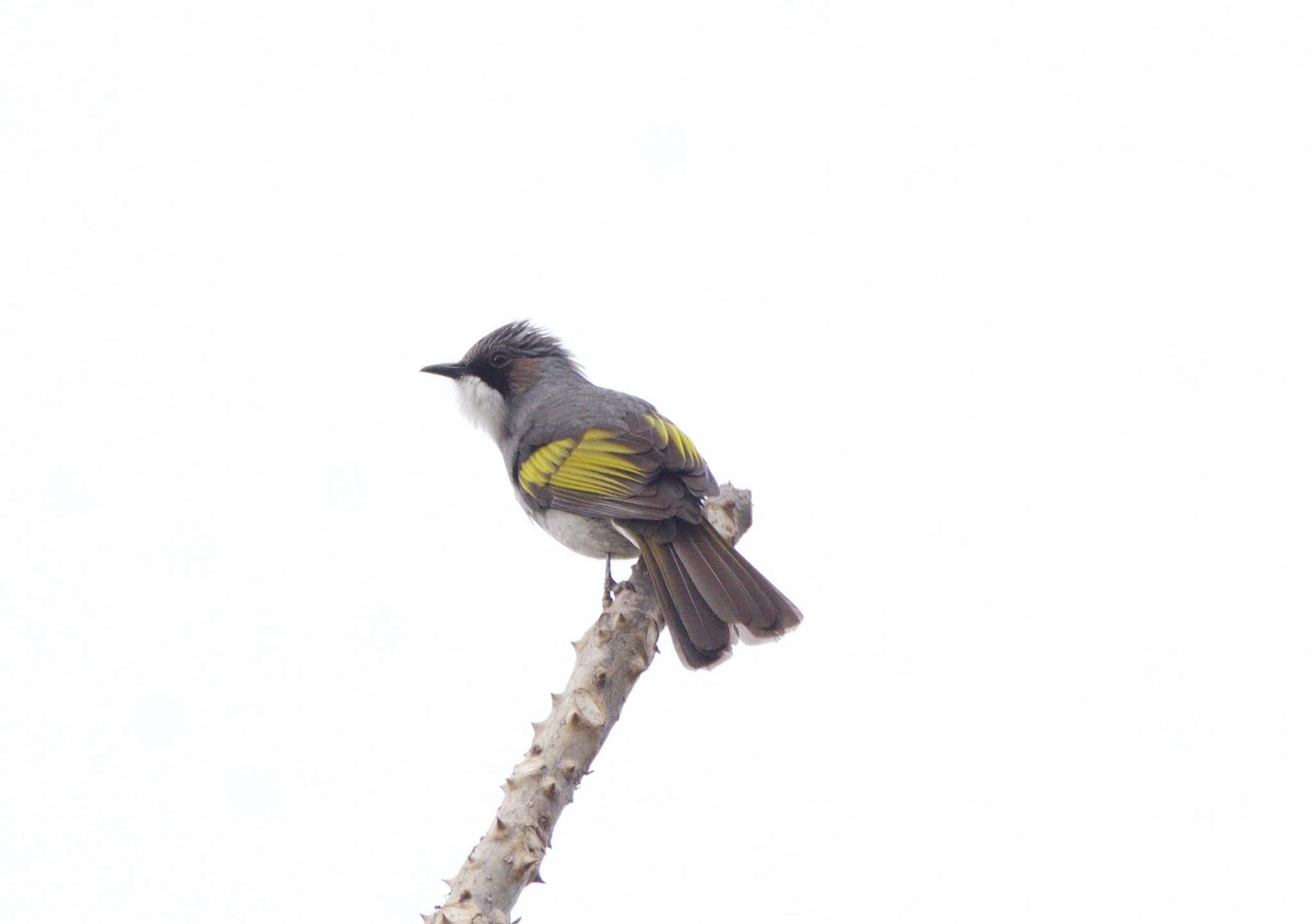
After lunch we headed back to the hide but it was pretty slow so we went back down the Sattal Road. Fortune smiled on us once again with another diminutive gem - Fire-breasted Flowerpecker. Further on we saw six of arguably the most attractive bulbul - Ashy Bulbul
and a lightening fast Shikra attacking three Blue-winged Sivas. That was it - we had a long journey up into the mountains the following day so headed back to the hotel to get as much rest as possible.
16.02.2020 Road to Chopta
This was 12 hours of motion sickness inducing twists and turns interspersed with traffic jams. A horrible journey despite the beauty of the surrounding hills. As always though, the day brought some great birds. The first one was Little Forktail near Kainchi Dham Ashram (of Zuckerberg fame). This bird had been frustratingly elusive in Sattal. Further on we saw Himalayan Buzzard and, at a tea stop in Mirai, a pair of Long-tailed Minivets (yellow - female; red - male).


We spent a few more minutes birding and picked up Egyptian Vulture - the first that Mahesh had seen at this altitude - as well as Upland Pipit, White-tailed Stonechat, White-capped and Rock Buntings, Black-throated Thrush, Steppe Eagle and a good number of Himalayan Vultures.


The road turned and twisted, dipped and rose but always with a net elevation as we steadily climbed. Passing one town we saw their refuse disposal site - a huge slide of rubbish down the hillside into a stream, presumably hoped to be washed further downhill by rain or snowmelt. This horrible spectacle provided an extraordinary spectacle of dozens and dozens of Steppe Eagles. As we approached the top of the rubbish slide a brown cloud of eagles lifted off. It was impossible to count but 100 is a very conservative number.


After a very long drive we eventually we arrived at Magpie Camp, a few kilometers from Chopta itself. It was significantly colder and higher than Pangot but the tent accommodation was more suited to the plains. The staff though, went to huge lengths to make us as comfortable as possible - extra blankets, hot water bottles and lots of delicious meals. The views were spectacular and the birds superb so any complaints I have seem rather petty. Below are two photos from the camp, taken as the first light hit the mountains.


17.02.2020 Chopta, Mandal
We started with the views above, hot tea and a walk up the road bringing Yellow-billed Blue Magpie, Himalayan Woodpecker, Eurasian Jay, the very smart-looking Variegated Laughingthrush,


Stripe-throated Yuhina,

Buff-barred Warbler and a Lammergeier - easily my favourite bird of prey.


Mahesh knew exactly where to go for the Monals and pretty soon we were driving slowly along a south facing road with near-vertical grass slopes. It wasn't long before one was seen - a female on the road in front of us. We spotted the male below but we'd spooked him and he didn't follow the female up onto the road and the higher slopes. Over the next couple of days we saw many Himalayan Monal. Each one was a delight and both male and female were stunning in their plumage - the males for their almost psychedelic colours and the females for the precision of their feather patterning offset by that brilliant blue orbital skin.


During the morning we also saw Alpine and Altai Accentors, Rufous-vented Tit, Grey-crested Tit, Golden Eagle, Black Eagle, a distant Mountain Hawk-Eagle and, on the way back to the camp a stunning Koklass Pheasant.


Snow Pigeon is a high-altitude bird and one that we really wanted to see. They are not particularly common and can be difficult to locate in this area so we were thrillled to see a group of four perched on a tree close to the camp. A Large-billed Crow disturbed them but not before we'd had some great views.


The trudge through the snow/slush/mud from the road to the camp was lightened by a great view of a Long-tailed Thrush. After lunch we headed downhill towards a village, stopping at a roadside waterfall to see Little Forktail.


Loads of birds in and around the village (Whistler's and Lemon-rumped Warblers, Blue-fronted Redstart, Pink-browed Rosefinch, Russet Sparrow etc) and the new ones for the trip were Speckled Pigeon and White-collared Blackbird.


It takes quite a while to get anywhere in the mountains so we left early and drove back to camp while it was still light.
18.02.2020 Chopta, Tungnath
This was our 'trek' day. We wanted to see Snow Partridge and a good place to see them is on the high ground near Tungnath Temple. At 3680 m it is the highest Shiva temple in Uttarakhand and one of the highest in the world. We started off well with Himalayan Monals, Variegated Laughingthrushes, Yellow-billed Blue Magpies and Himalayan Vultures in abundance. A distant party of bullfinches heading into the flowering Rhododendron trees were identified as Red-headed Bullfinches


and a couple of Green Shrike-babbler were new on the list for everyone. However, as we headed up the path to the temple underfoot conditions became icier and icier. We halted for lunch a short distance below the temple where we had distant views of our target Snow Partridge.

Stunning views all around.


Binoculars and heavy cameras made walking on icy paths a risk that Rod and I weren't happy to take so we decided to head back down. It wasn't that dangerous to proceed on up to the temple but a slip and fall was increasingly likely and would have been the end of some expensive kit. On the way down we were passed by a couple of local villagers....

Here I was struggling with my beautifully engineered Hanwag boots and this guy was wearing flip-flops! Humbled.
After some warming tea at Chopta we went back to Magpie Camp, picking up a pair of Mrs Gould's Sunbird right on the turnoff to the camp. Very nice. We were in our tent by late afternoon and the sun had warmed it to sauna heat (lovely). We met Mahesh for tea and picked up Ashy-throated Warbler and Yellow-browed Tit in a mixed flock passing by the camp. Last bird of the day was Mountain Scops Owl calling.
19.02.2020 Chopta, Mandal
First bird of the day was the Mountain Scops Owl, still calling. Once again we were heading down hill for birding, this time to Mandal, a small village and home to the Herbal Development and Research Unit. On the way down we spotted more Monal, Red-billed Chough and a flock of Snow Pigeon feeding together.

A little further on we stopped by another car. A couple of birders were there being guided by a friend of Mahesh's. We told them about the feeding party and they returned the favour by pointing out a pair of White-browed Fulvetta. We continued downhill stopping occasionally at likely places. At one of these we finally caught up with a very fine looking Scaly-bellied Woodpecker.


A quintet of Yellow-throated Martens piled out of a nearby tree and, one by one crossed the road and disappeared upslope. Delightful animals.

One last stop before the village brought our second treecreeper species - Hodgson's Treecreeper and a pair of Speckled Pigeon.

The birding around Mandal was extraordinary - blue-fronted Redstart, Black-throated Thrush, Striated Laughingthrush, Grey-headed and Brown-fronted Woodpeckers, Grey Treepie, Grey Bushchat, Black-throated and Yellow-browed Tits, and many other species we'd already seen. We were here looking for Scarlet Finch and within a few minutes we came across a small flock of these impossibly scarlet birds. They didn't stay around for long, moving rapidly from shrub to tree and away up the hillside.


Pawan then found what was, for me, one the top five birds of the trip - Chestnut-headed Tesia. This was a serious shade skulker, on a par with the cupwings, but its chestnut head, white eye cresent and yellow underparts make it a real show stopper. A male Pink-browed Rosefinch spent a couple of minutes in the open providing us with some superb views.

A new scimitar babbler species for the trip - Streak-breasted Scimitar Babbler - showed briefly and then disappeared into the thick scrub. We saw c. 35 species here - a very productive morning. On the way out a Chestnut-bellied Rock Thrush showed.

We watched a group of House Swifts while we had tea in the village and then, surprise of the week, a male Pink-browed Rosefinch hopped along the alley beside the tea-house and started feeding in the mud behind the rubbish bin. On the way back to camp we stopped at the Scaly-bellied Woodpecker place and heard a distant Black-and-yellow Grosbeak calling, found two Mistle Thrush, White-collared Blackbird, Lammergeier, two Alpine Thrushes


and, a bit further on about nine Monal, ten Altai Accentors, Grey-crested and Yellow-browed Tits, another White-browed Fulvetta and the bizarre sight of 50+ Great Cormorant heading towards the high mountains.

20.02.2020 Road from Magpie Camp to Walterre, Dehradun
This was always going to be a tough day and, indeed, it turned into a 15 hour ordeal of traffic jams. Google maps shows the travel time to be around 6.5 hours for 215 km. The problem lay in the road widening project that seemed to be 100 km long. Widening the road means digging back the mountainside and construction/destruction was continuing 7 days a week. Everytime the road was blocked by heavy machinery or too narrow for two trucks to pass everything stopped and backed up. Very slow progress indeed. What was not making slow progess was my last meal through my disgestive system and it was with fortunate timing and huge relief that we found a rare layby that was not in the middle of a traffic jam (where everyone gets out of their cars and walks around). Despite my personal discomfort we had some really, really good birds. Alpine and Black-throated Thrushes, Khalij Pheasant, Spotted Forktail, a flock of 20 Red-headed Bullfinches from the road and, at a small village where we stopped for tea, Wallcreeper, Brown Dipper, Cinereous Vulture and. . .
Yellow-rumped Honeyguide!


While the majority of the birds we saw were new to Rod and me this was a very good local bird and new for us all. This Honeyguide should be found a lot further east along the Himalayas and we were really fortunate to see it.
We finally arrived at the welcoming and comfortable Walterre hotel just as rain was falling. This was the first rain of the trip in an otherwise cloud-free holiday. What was rain at low altitude was snow higher up and we heard that Chopta was cut off by snowfall. This is a common occurence but it would have been severly problematic for our schedule (not getting to Delhi for our outbound flights) had the weather front moved in a few hours earlier.
21.02.2020 Walterre, Dehradun
Went to sleep in a warm room and warm bed to the relaxing sound of rain. It was still raining in the morning and this was a relief in many ways. Rod and I were getting pretty tired after almost two weeks of long days birding and the thought of heading out to a rainy Asan Barrage was not particularly enticing. So, we had tea and decided to bird the hotel gardens and, when the rain got too heavy, use the covered balcony. Good choice. 26 species including the undoubted passerine of the trip: Rufous-bellied Niltava. This had the electric blue head band and shoulder patches of Small Niltava but also beautiful rufous underparts. A real stunner. Another new bird was Maroon Oriole but the gardens also produced Grey-winged Blackbird, Black-throated Thrush, Buff-barred Warbler, Blue-fronted Redstart, Red Junglefowl, Black-winged Stilt(!), Green-tailed and Crimson Sunbirds, Chestnut-bellied Rock Thrush, Slaty-blue Flycatcher, Red-whiskered and Black Bulbuls, Blue-throated Barbet, Long-tailed Minivet and a real prize in the form of an Orange-headed Thrush.
We left around 11:00 a.m. for the long drive to Delhi and our outbound flights. It was an amazing trip and I am indebted to Mahesh and Pawan for their care, skill and professionalism throughout our time together.
Total Species: 271
N.B. Haripur Dam is also known as Baur Reservoir
We finished around lunchtime and prepared for the next stage of the trip - Sattal and then up to the mountains to Chopta.


